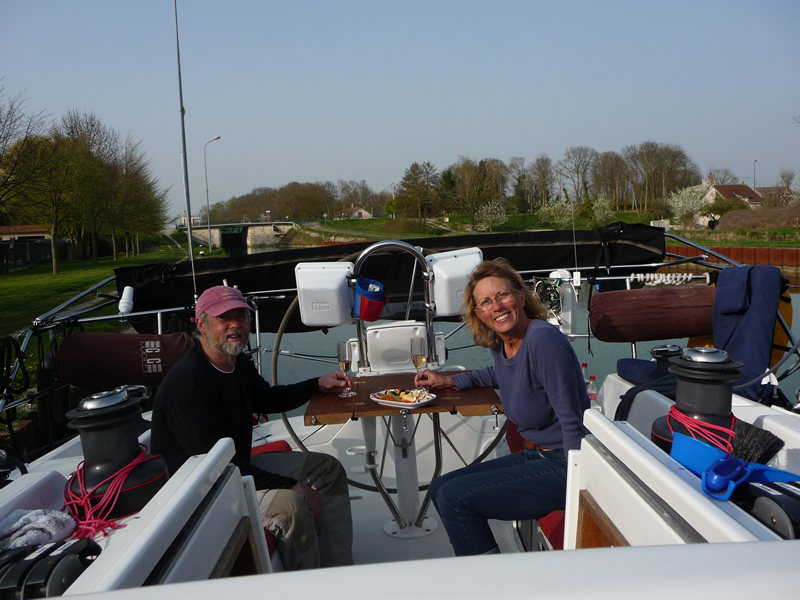
Yes – the Grateful Red can sail in the Dutch canals!

The Dutch canal system included a couple of sails. On day two the Grateful red entered the Kagerplassen chain of five lakes. The five lakes together were about the size of Lake Mendota in Madison – maybe 10,000 acres. Yet the lakes were covered with boats – a number of boats the size of the Grateful Red. The lake varied in depth from six feet (we were scrapping the bottom) to thirty feet. In the 1800’s these lakes were “mined” for peat. The deep part of the lake was the most mined. The area was called Haarlemmermeerpolder (the name just rolls off the tongue). A polder being a low-lying tract of land enclosed by dikes that forms land that has no connection with outside water other than through pumping devices. I think that only the Dutch have polders.

Amsterdam’s Schiphol airport name is derived from Haarlemmermeerpolder which in the 1850’s was a large shallow lake which had sudden violent storms that would claim many sailing ships. This was the main reason for reclaiming the land. In English, Schiphol’s name means “ship hole” or “ship’s hell”, a reference to the number of ships lost in Haarlemmermeerpolder. Kagerplassen was pretty tame when we sailed across including docking at the local lakeside bar/restaurant recommended by Leneke for wine, beer and food.
We had a little-low bridge problem and had to sail across the Kagerplassen chain of lakes twice – the stand-mast or mast-up canal route goes over the four lane highway bypassing opening a bridge and stopping traffic on the four lane highway . Kinda of neat going over a four lane highway in a forty foot ten ton sail boat mast up in a canal.

Finally we arrive at the Braassemermeer, known locally as the Braassem, a 425 acre lake (Kegonsa is approximately 3,000 acres) located in the town of Braassem Kaag, with Roelofarendsveen on the west and Rijnsaterwoude on the east bank. Remember those names Het meer is een restant van de Leidsche Meer en niet veroorzaakt door turfwinning. The lake is a remnant of the Leyden peat extraction. One enters the lake through a lock that closes for lunch as we and a number of other sailing vessels learned. Once through the lock all the boats put up their sails – we rolled out the genoa, had a couple cold beverages (well maybe one quick beer) and sailed across the lake plus more before again entering the stand mast canal route.
Our last sail for the season – after over 6,000 miles of sailing was in the Volkerak. Volkerak was previously saltwater, and now with Dutch dikes, pumping devices and sluices is all fresh water sailing. To get in and out of Volkerak we needed to go through a couple of sluices. A sluice is a type of lock (again probably only in the Netherlands) – a sluice lets water out of the polder in low tide and prevents saltwater from entering the polder at high tide. With a twenty meter mast we had to go through the commercial sluice with the BIG shipping vessels. Once in Volkerak, the Genoa went back out and we tried (the wind was looooooww) one last sail of the season.

Finally the crack canal crew of Larry, Ron, Janet and Kristine dropped the sail one last time for the season, folded the sail on the deck, broke out the rum and cokes and motored into Bruniesse harbor. Home of the Grateful Red for the winter.


Bruinesse Welcome Mussel!